×
×
×
×
NEW
Edition : 1 | Volume : 1
Publishing Year : 2025
Langage : English
Publisher : South India Book Traders
Author/s :
Dr. Imamasheb S. Jatth , Mr. Shreedhar D , Dr. Jnaneshwar B. Gopali
Availability :
Hard Bond
ISBN: 9789349317611
Publishing Year: 2025
Paper Back
ISBN: 9789349317420
Publishing Year: 2025




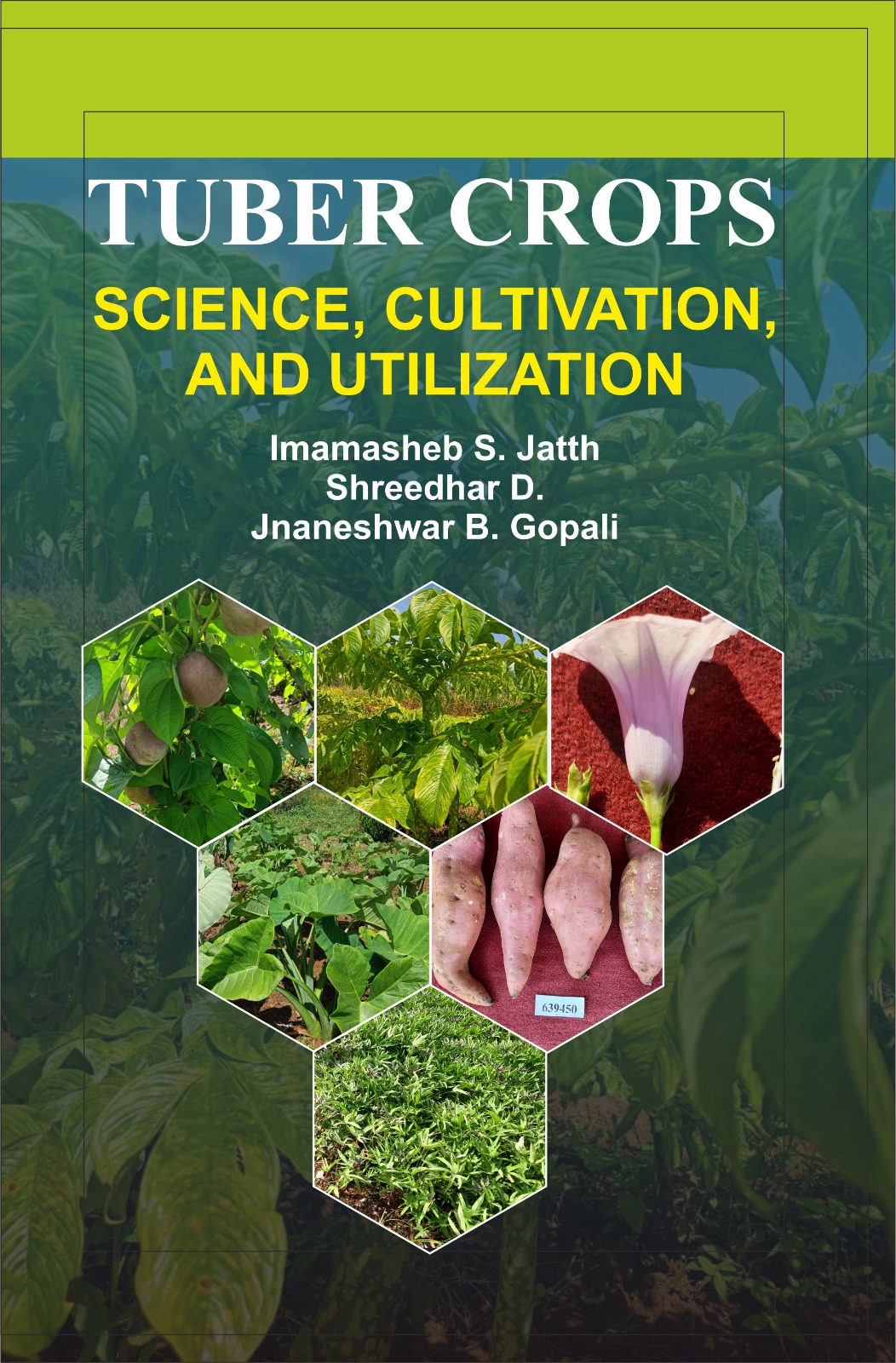
Tuber crops have long been recognized as crops of immense significance for food, nutrition, and livelihood security, especially in tropical and subtropical regions. Despite their adaptability to marginal environments, their rich nutritional profile, and their growing role in climate-resilient agriculture, tuber crops have not received the same attention as cereals and pulses in mainstream research and academic literature. The available information on their botany, cultivation, and utilization remains scattered across research articles, institutional reports, and extension manuals, making it difficult for students, researchers, and practitioners to access
consolidated knowledge. This book, “Tuber Crops: Science, Cultivation, and Utilization”, has been conceived to fill this gap by providing a comprehensive and systematically organized resource. It covers the scientific, agronomic, and practical aspects of both major and minor tuber crops, including their botanical description, origin and distribution, climate and soil requirements, varietal wealth, propagation techniques, agronomic practices, pest and disease management, harvesting, post-harvest handling, and diverse utilization avenues. Special emphasis has been given to their nutritional and industrial importance, climate-smart role in sustainable agriculture, and prospects for value addition and entrepreneurship.
The book is organized in a student-friendly manner with a focus on clarity, systematic presentation, and examination orientation. It has been designed to serve the needs of undergraduate and postgraduate students of agriculture and allied sciences, as well as aspirants of competitive examinations such as ICAR-JRF, SRF, NET, ARS, and State Agricultural Services. At the same time, it will be equally useful to researchers, extension personnel, policymakers, farmers, and entrepreneurs interested in tuber crop improvement, cultivation, and utilization. I am deeply indebted to my teachers, colleagues, and institutions, especially the University of Horticultural Sciences, Bagalkot, the AICRP on Tuber Crops, Dharwad Centre, and the ICAR-Central Tuber Crops Research Institute, Thiruvananthapuram, for their valuable contributions and
inspiration.
Dr. Imamasheb S. Jatth

Dr. Imamasheb S. Jatth (b. 1986) is a renowned horticultural
scientist specializing in vegetable and tuber crops. He holds a Ph.D. in
Vegetable Science from the University of Horticultural Sciences, Bagalkot, with
outstanding academic achievements in both his master’s and bachelor’s degrees. Currently,
Dr. Jatth serves as Principal Investigator, AICRP on Tuber Crops at the
Regional Horticultural Research and Extension Centre (RHREC), Dharwad,
Karnataka. With more than 15 years of experience in teaching, research, and
extension, he has guided postgraduate students, developed course materials, and
served as examiner across universities. His research leadership has resulted in
over 60 AICRP trials, including genetic resource conservation, weed and
nutrient management, pest surveillance, and popularization of tuber crops in
non-traditional areas. He has co-developed new crop varieties such as tomato
RFT-1 (DTS-1), oriental pickling melon BCMCO-04 (Prabha), arrowroot Sree
Karthi, and sweet potato TSP 16-7. Dr. Jatth has authored 60 research papers,
28 abstracts, 15 popular articles, and 2 books/chapters, while serving on
editorial boards of reputed journals. He has received several honors, including
the Indo-Asian Nicolas Appert Distinguished Scientist Award (2020), multiple
Young Scientist Awards, and consecutive ICAR-CTCRI National Revenue Generation
Awards (2022–2025). Actively engaged in farmer training, consultancy, and
outreach, he has organized numerous field demonstrations, tuber melas, and over
30 training programs across Karnataka. His efforts in research, innovation, and
knowledge transfer have made a significant impact on farmers’ livelihoods and
sustainable horticultural development in India.
Table of Contents..
1 General Principles and Importance
2 Botanical and Morphological Characteristics
3 Nutritional and Economic Significance Major Tuber Crops
4 Sweet Potato (Ipomoea batatas)
5 Cassava (Manihot esculenta)
6 Yams (Dioscorea spp.)
7 Taro (Colocasia esculenta)
8 Elephant Foot Yam (Amorphophallus paeoniifolius) Minor and
Underutilized Tuber Crops
9 Chinese Yam (Dioscorea polystachya)
10 Jerusalem Artichoke (Helianthus tuberosus)
11 Arrowroot (Maranta arundinacea)
12 Coleus (Solenostemon rotundifolius)
13 Lesser Yam (Dioscorea esculenta)
14 Chinese Potato (Coleus parviflorus Benth) Appendices
15 Glossary of Technical Terms
16 Conversion Tables and Formulae
17 List of Research Institutions Working